Clean Agent Fire Extinguishers
Clean agent extinguishers that discharge without leaving residue. Used around sensitive electronics and high-value equipment.
Categories
Main Categories
Fire ExtinguisherFire Detection & Alarm SystemsFire Suppression SystemsExtinguisher Components & PartsExtinguisher Refilling MaterialsHydrant Systems & PartsPersonal Protective Equipment (PPE)Fire Safety SignageEmergency Lighting SystemsFire Doors & Passive ProtectionFire Safety Tools & AccessoriesFire Safety Storage & CabinetsIndustrial Fire Safety EquipmentMarine & Special Application EquipmentFire Safety Training EquipmentMonitoring & Control SystemsFire BlanketsConsumables & Maintenance SuppliesRelated in Fire Extinguisher
K Class Kitchen Fire ExtinguisherABC Fire ExtinguishersBC Powder Fire ExtinguishersWater & Foam Fire ExtinguishersCO2 Fire ExtinguishersClean Agent Fire ExtinguishersLithium Ion Fire ExtinguisherSpecial Application Fire ExtinguishersAutomatic Modular Type Fire Extinguishers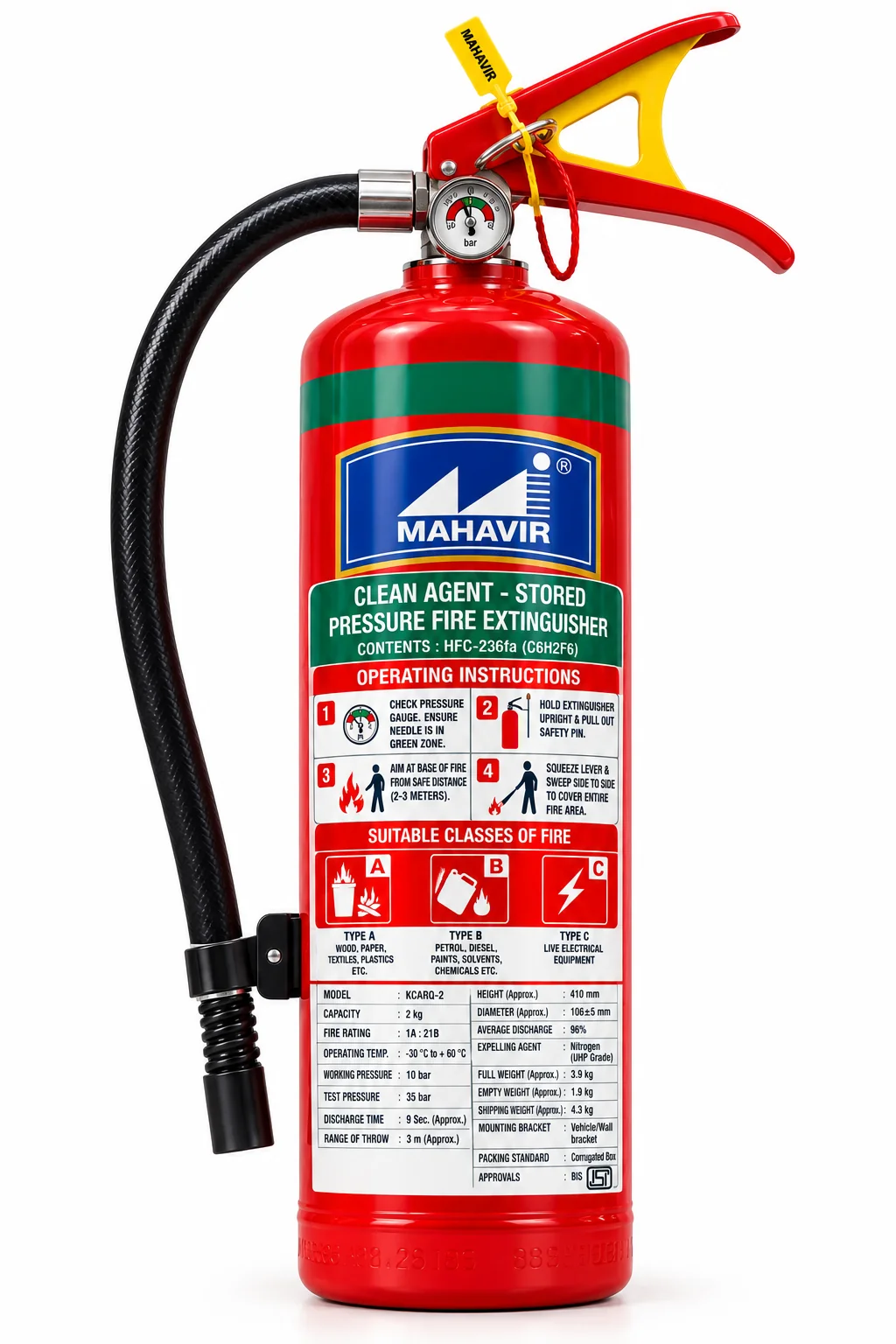
Clean agent fire extinguishers for sensitive equipment
Clean agent fire extinguishers put out fires without leaving powder, foam or liquid behind. That makes them the right choice where a discharge of dry powder or foam would do more harm than the fire itself: server rooms, control panels, electrical rooms, laboratories and rooms with costly electronic equipment.
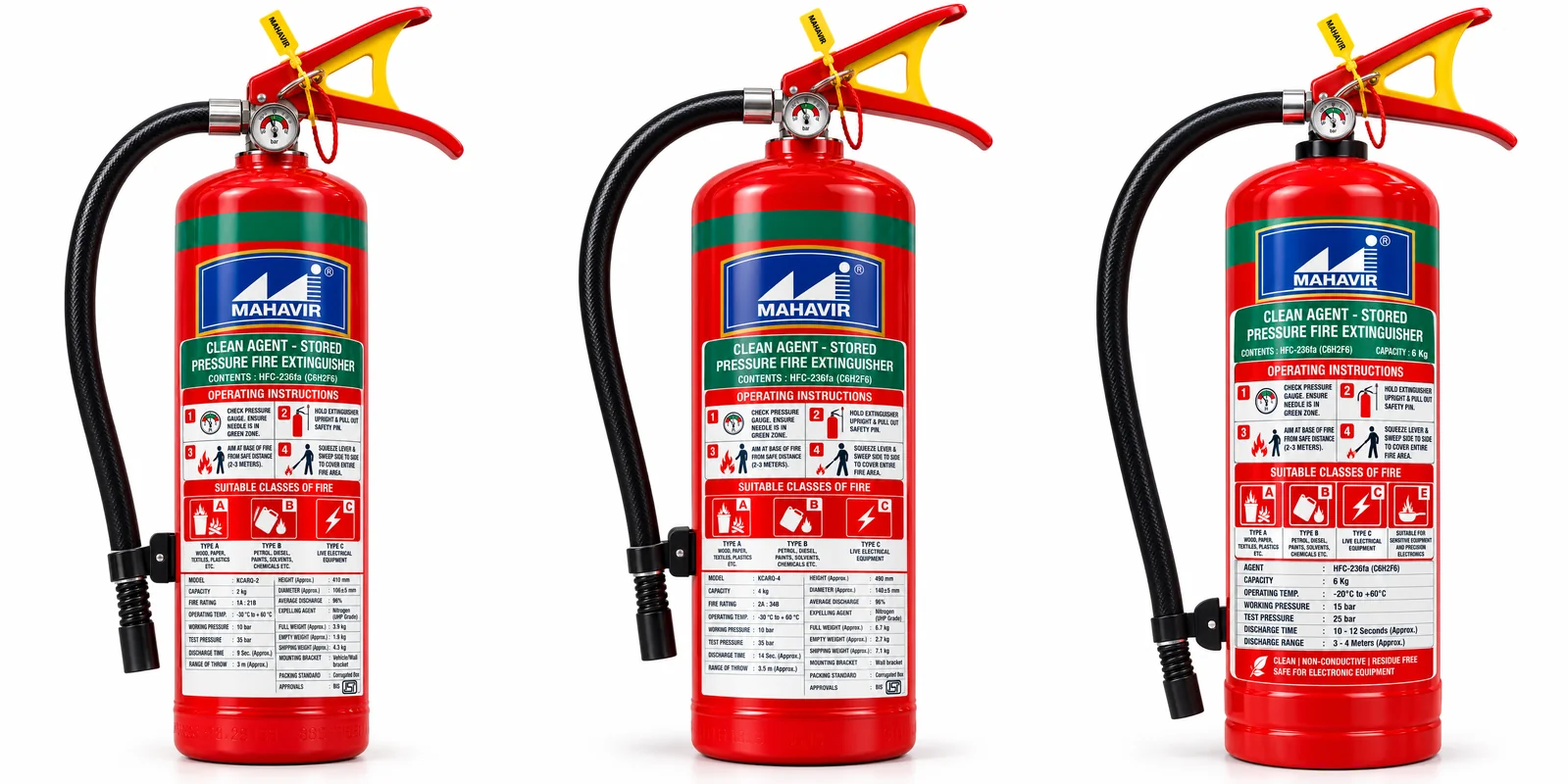
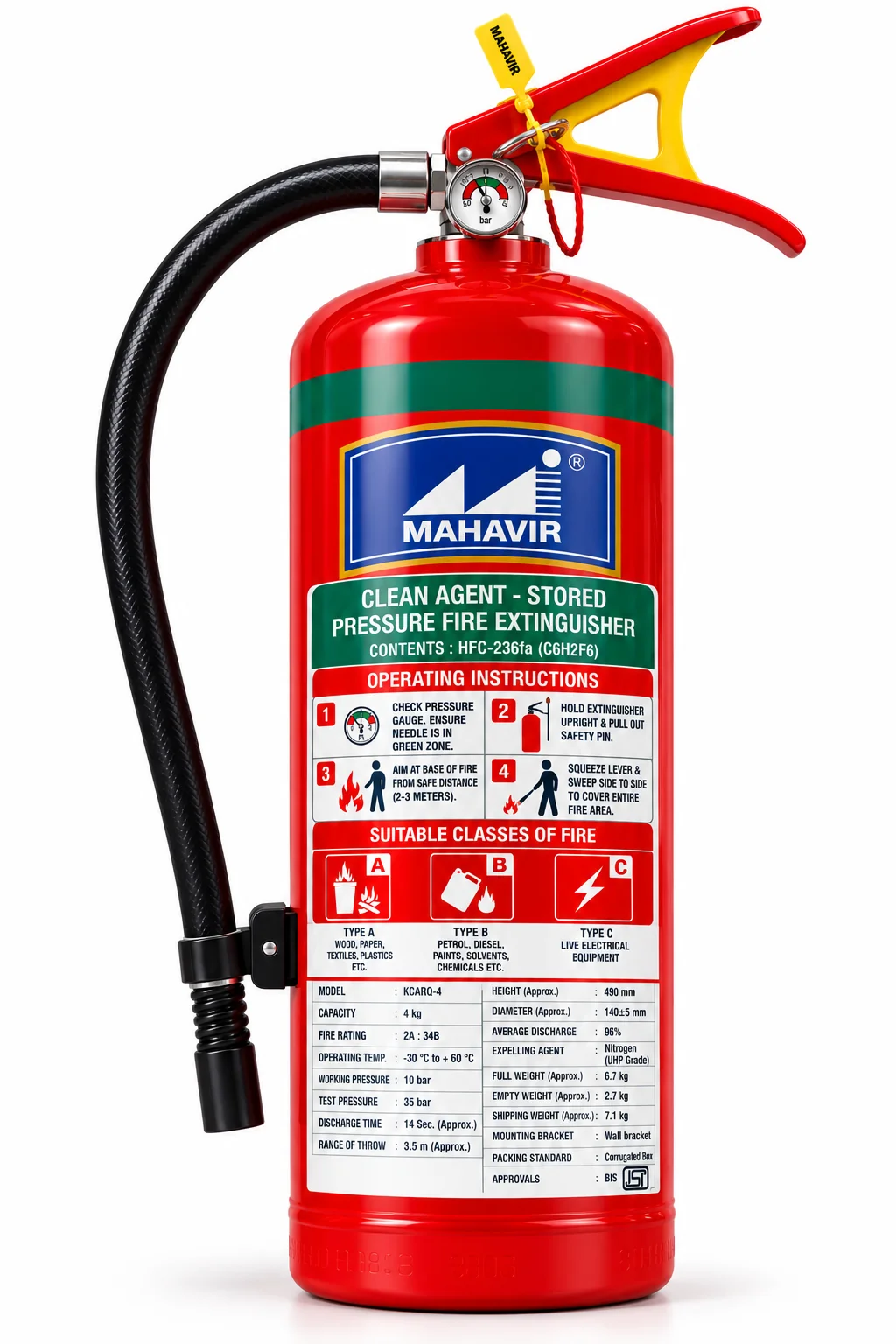
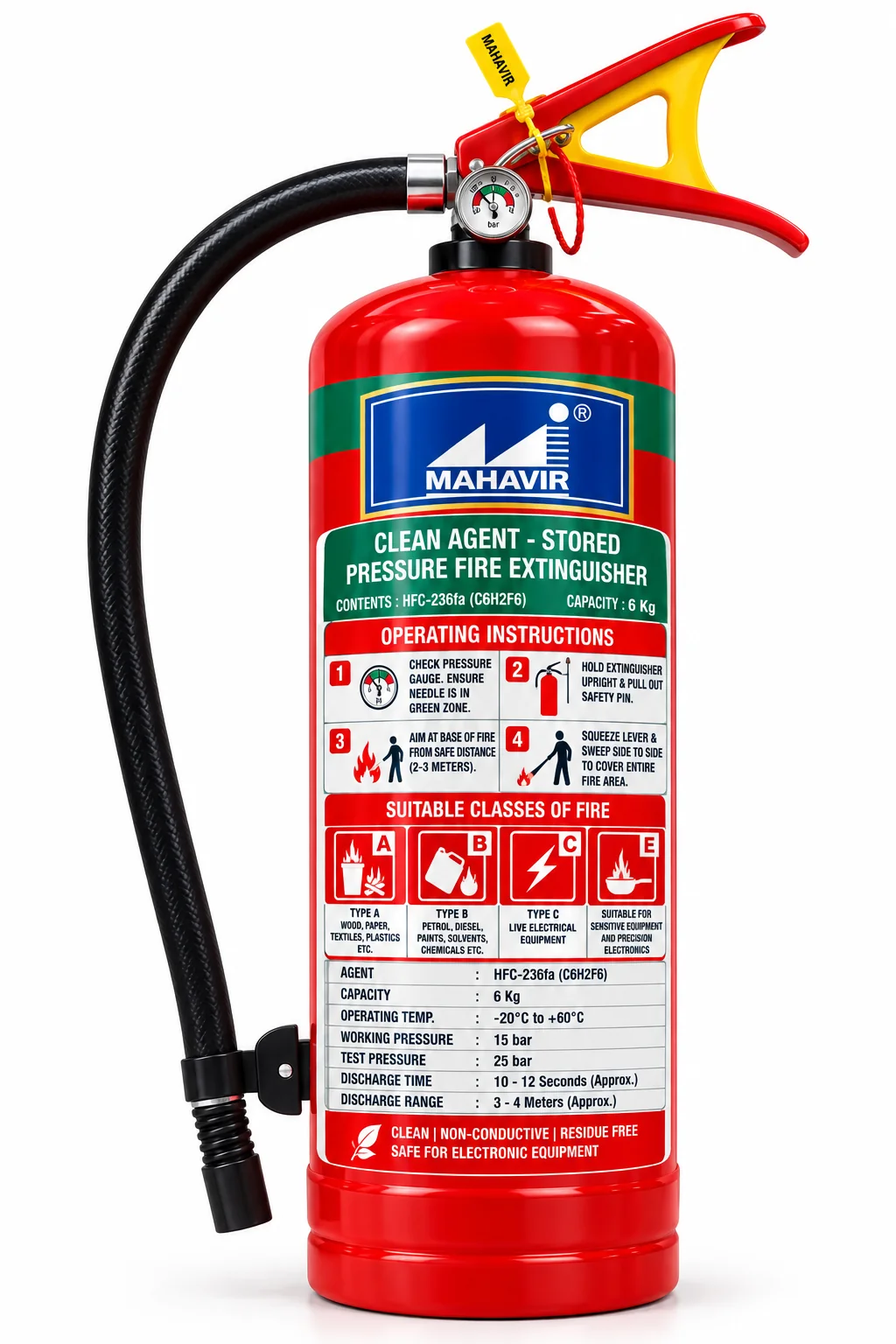
Our MAHAVIR clean agent extinguishers use HFC-236fa, a non-conductive agent that evaporates after discharge. They are marked for Class A, Class B and Class C fires, covering solid combustibles, flammable liquids and live electrical equipment.
Munshi Fire Safety supplies clean agent fire extinguishers in 2 kg, 4 kg and 6 kg capacities. Contact us to discuss the right size and number of extinguishers for your rooms.
Need help choosing the right capacity for your application?
Enquire About Clean Agent ExtinguishersHow a clean agent extinguisher puts out a fire
- 1
Discharge the clean agent
The stored-pressure extinguisher releases HFC-236fa through the hose and nozzle onto the base of the fire.
- 2
Absorb heat and interrupt the fire
The agent takes heat out of the fire and interferes with the combustion process, so the flames die down.
- 3
Evaporate without residue
After discharge the agent evaporates, leaving no powder, foam or liquid to clean up and no residue on sensitive equipment.
Always check that the pressure gauge needle is in the green zone before use. Ventilate the room after discharge and avoid breathing the vapour.
Where clean agent extinguishers are used
Server rooms & data centres
Server racks, network cabinets and IT rooms where residue would damage costly electronic equipment.
Control rooms & electrical panels
Switchgear rooms, MCC and control panel rooms, UPS and battery rooms and substations.
Laboratories & telecom rooms
Test and research laboratories, telecom exchanges and rooms holding precision instruments.
Offices, archives & vehicles
Offices, records rooms and vehicles where a clean discharge with no cleanup is important.
Site-specific fire-safety requirements should be assessed before selecting equipment. Larger data rooms and critical areas are normally protected by a fixed clean agent or other suppression system, with portable extinguishers as back-up.
Why electronic equipment needs a different extinguisher
Water and foam conduct electricity+
Water-based extinguishers can create a shock hazard around live equipment and damage it.
Dry powder leaves residue+
Powder can get into circuits, connectors and fans, and is hard to clean off. It can damage equipment even after the fire is out.
Downtime is costly+
Cleanup after a powder discharge can mean long outages and expensive replacement. A clean discharge helps you get back to work sooner.
Fires spread along cables+
A small fire in a panel or rack can spread quickly along cables, so quick action with the right extinguisher matters.
What to do when electrical equipment catches fire
Raise the alarm and, if it is safe to do so, switch off the power to the equipment. If the fire is small and you are trained, check that the gauge is in the green zone, pull the pin, aim at the base of the fire from 2-3 metres and sweep from side to side. Leave the area, ventilate it afterwards and call the fire service if the fire is not quickly controlled.
Key features of clean agent extinguishers
- HFC-236fa clean agent, discharged without residue
- Non-conductive, for use around live electrical equipment
- Suitable for Class A, B and C fires
- Stored pressure type with a pressure gauge and green zone
- Tamper seal on the safety pin to show mishandling
- Hose and nozzle discharge with a lever
- BIS approved, ISI marked (2 kg and 4 kg models)
- Easy to operate, maintain and recharge
Why choose a clean agent fire extinguisher?
- Leaves no residue after discharge
- Non-conductive and safe around electrical equipment
- Suitable for Class A, B and C fires
- Compact, lightweight and easy to operate
Clean agent fire extinguisher specifications
Compare the available clean agent fire extinguisher capacities and their product specifications.
- Manufacturer
- MAHAVIR
- Extinguishing Agent
- HFC-236fa (C6H2F6) clean agent
- Model
- KCARQ-2
- Capacity
- 2 kg
- Design
- Hose & Nozzle
- Fire Rating
- 1A : 21B
- Height (Approx.)
- 410 mm
- Diameter (Approx.)
- 106±5 mm
- Average Discharge Time
- 9 Sec.
- Average Range of Throw
- 3 m
- Average Discharge
- 96%
- Operating Temperature
- -30 °C to +60 °C
- Service / Max. Service / Test Pressure
- 10 / 12 / 35 bar
- Expelling Agent
- Nitrogen (UHP Grade)
- Full Weight (Approx.)
- 3.9 kg
- Empty Weight (Approx.)
- 1.9 kg
- Shipping Weight (Approx.)
- 4.3 kg
- Packing Standard
- Corrugated Box
- Mounting Bracket
- Vehicle / Wall bracket
- Approvals
- BIS (ISI marked)
Clean agent fire extinguisher FAQs
What is a clean agent fire extinguisher?
A clean agent extinguisher contains a gaseous extinguishing agent, here HFC-236fa, that evaporates after discharge and leaves no residue. It is used to protect sensitive equipment such as servers and electrical panels.
Can a clean agent extinguisher be used on live electrical equipment?
Yes. HFC-236fa is non-conductive and the extinguishers are marked for Class C fires. Where possible, also switch off the power and keep a safe distance.
What sizes of clean agent extinguishers are available?
The range includes 2 kg, 4 kg and 6 kg models. The right size depends on the room, the equipment in it and your site risk assessment.
Is clean agent gas environmentally friendly?
HFC-236fa has no ozone depletion potential, but like other HFCs it is a greenhouse gas. For this reason clean agent extinguishers are best used where their residue-free discharge matters, and should be recharged and disposed of properly.
What is the difference between clean agent, CO2 and dry powder extinguishers?
Dry powder is effective but leaves a residue that can damage electronics. CO2 also leaves no residue but is mainly for Class B and electrical fires. Clean agent leaves no residue and is marked for Class A, B and C fires on our models.
Can I use it on a cooking oil fire?
No. Cooking oil and fat fires need a Class K wet chemical extinguisher. See our K Class kitchen extinguishers for those hazards.
Do clean agent extinguishers need refilling and servicing?
Yes. They should be inspected regularly and recharged after any use. Munshi Fire Safety also provides refilling and servicing.
Do you supply clean agent extinguishers in Vapi, Valsad and Daman?
Munshi Fire Safety serves customers in the Vapi, Valsad and Daman region. Contact us with your room details and required quantity to discuss supply.
Need help choosing?
Our safety experts can guide you.
Rules and standards for fire extinguishers
ISI mark rules, extinguisher types by fire class, and the inspection and testing schedule.
ISI Mark on Fire Extinguishers: The 2023 Quality Control Order
Extinguishers in India must carry the ISI mark under the 2023 Quality Control Order. See what it says, the standards covered and how to verify a BIS licence.
Read the guideFire Extinguisher Types and Fire Classes in India
The BIS fire classes A, B, C, D and F, which extinguisher suits each, and the difference between portable and wheeled extinguishers.
Read the guideFire Extinguisher Inspection, Refilling and Testing Schedule in India
A practical extinguisher schedule for Indian sites: monthly checks, yearly maintenance, 3-year and 5-year hydrostatic tests, and what records to keep.
Read the guide