Product Details
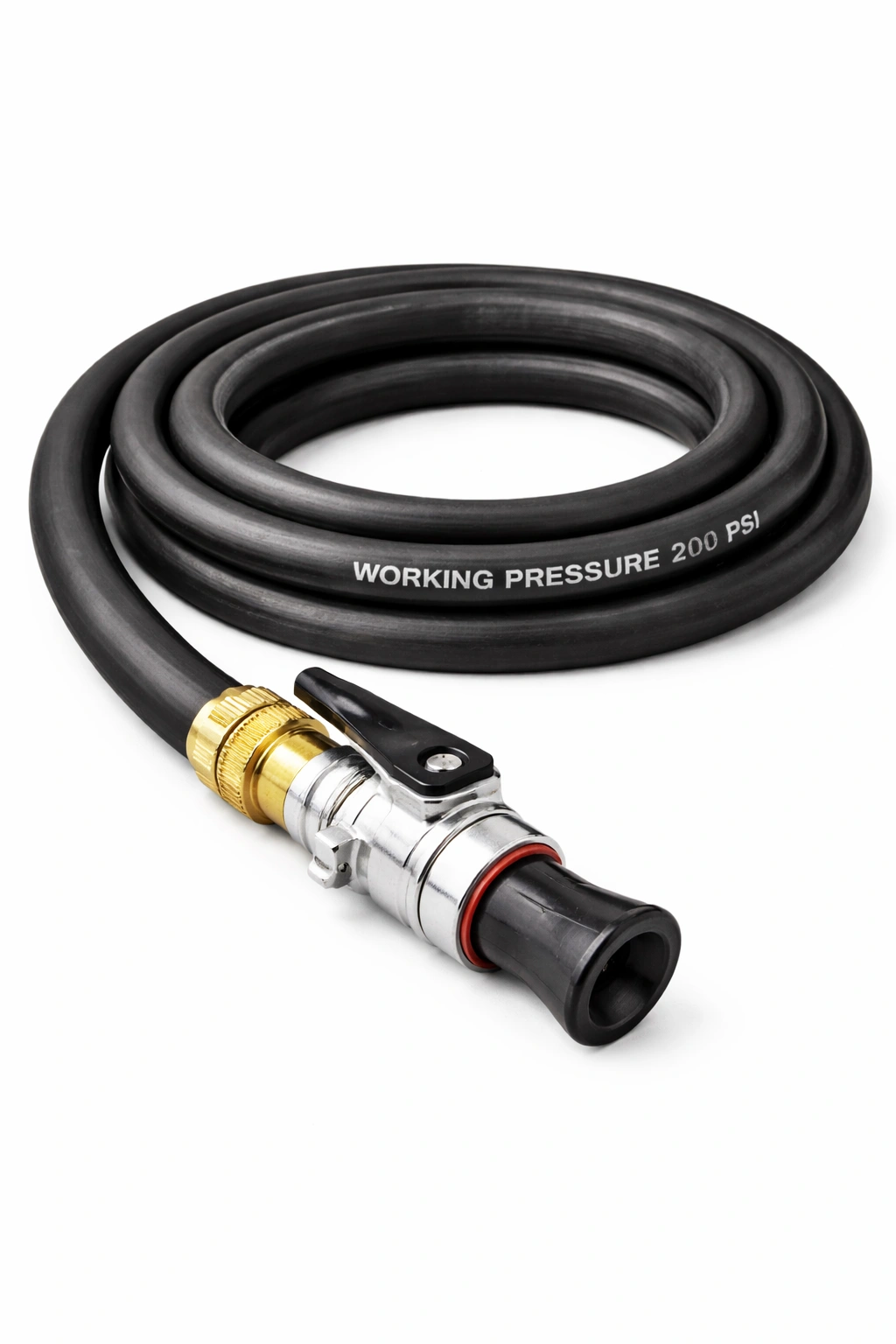
Extinguisher Discharge Hose – EPDM Rubber with Brass Coupling
Quality Assured
Premium Products
Expert Support
We're here to help
Description
The discharge hose is the operator's directional control link between the extinguisher valve and the fire. It allows the user to aim the agent stream precisely at the base of the fire while keeping the heavy cylinder at a comfortable working distance. On extinguishers above 4 kg, the hose is not optional—it is a code-mandated component per IS 15683, because aiming a rigid nozzle mounted directly on the valve of a 6 kg or 9 kg cylinder at a floor-level fire is impractical and dangerous.
This hose is constructed from EPDM (ethylene propylene diene monomer) rubber, selected for its excellent resistance to ozone ageing, UV degradation, and the full range of fire-extinguishing agents including dry chemical powder, AFFF foam, water, and wet chemical solutions. The inner tube is smooth-bore to minimise flow resistance, while the outer cover is textured for grip and abrasion resistance.
Each hose is supplied with a brass swivel coupling at the valve end (to prevent kinking during discharge) and a moulded or crimped nozzle adapter at the discharge end. The swivel coupling threads match IS 15683 valve outlet specifications. Hose lengths are standardised at 400 mm for 2–4 kg extinguishers and 600 mm for 6–10 kg units. Longer hoses are available for wheeled (trolley-mounted) extinguishers.
Hose failure is one of the most commonly cited reasons for extinguisher rejection during annual servicing. UV exposure, ozone cracking, rodent damage, and physical abuse (hanging objects on the hose, using it as a carrying handle) all contribute to degradation. A hose that shows surface cracking, hardening, softening, kinking, or coupling looseness must be replaced—there is no repair for a compromised rubber hose.
During every refill, the hose should be visually inspected externally, internally (blow through it and check for blockage), and pressure-tested at 1.5× working pressure per the IS/EN test protocol. Hoses that pass inspection are re-attached with new thread sealant on the coupling; those that fail are discarded and replaced.
Storage of spare hoses is straightforward: hang them loosely in a cool, dark area away from UV light, ozone-generating equipment (electric motors, welding sets), and chemical solvents. Do not coil them tightly or stack heavy objects on them, as permanent deformation compromises flow and coupling alignment.
Frequently Asked Questions

Stay Informed: Fire & Safety News and Updates
Subscribe to our newsletter for timely announcements on the latest government fire safety regulations, industry standards, newly released safety equipment, and product availability. Whether it's new product launches or critical rule changes, we'll keep you up to date so you can stay prepared.